
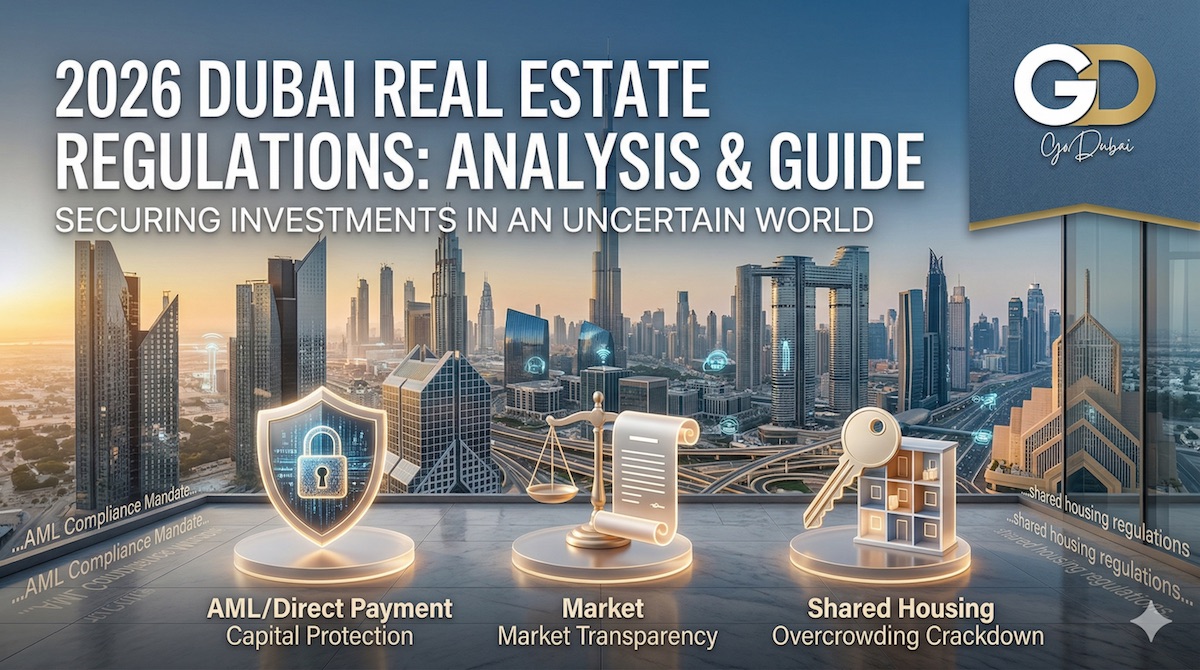
Dubai Investment Strategy 2026
Table of Contents
- 1. The Shared Housing Law: Ending Overcrowding and Elevating Living Standards (Law No. 4 of 2026)
- 2. The Direct Payment Mandate: A New Era of AML Compliance for Overseas Sellers
- 3. Tighter Escrow Controls & The 5% Retention Rule
- 4. Market Transparency: The Three-Broker Rule & Trakheesi Enforcement
- Why These Rules Cement Dubai as the Ultimate Safe Haven
- Frequently Asked Questions (FAQ)
The year 2026 has tested the resilience of global markets. With the geopolitical volatility and regional turbulence witnessed in the early months of the year, international capital immediately began seeking a secure, insulated, and highly regulated fortress. Once again, Dubai has emerged not just as a regional sanctuary, but as the premier global safe haven for high-net-worth individuals and institutional investors.
However, Dubai’s leadership understands that maintaining this “safe haven” status requires more than just geographical distance from conflict; it requires ironclad legal frameworks that protect capital, ensure transparency, and eliminate systemic risks. In response to the shifting global landscape, the Dubai Land Department (DLD) and the Real Estate Regulatory Agency (RERA) have rolled out a series of landmark legislations in 2026.
From strict Anti-Money Laundering (AML) mandates to the revolutionary Shared Housing Law, these updates fundamentally alter how properties are bought, sold, and managed in the emirate. For international investors, these laws offer unprecedented protection. For brokers and real estate professionals, mastering these regulations is the key to closing high-ticket deals in a competitive market.
Below, we break down the most critical Dubai real estate laws of 2026 and explore how they impact your investment strategy.
1. The Shared Housing Law: Ending Overcrowding and Elevating Living Standards (Law No. 4 of 2026)
One of the most significant social and structural changes introduced this year is Law No. 4 of 2026, targeting the regulation of shared accommodations across the emirate. As Dubai’s population continues its rapid expansion, the demand for affordable housing has historically led to the unauthorized partitioning of villas and apartments.
To preserve the infrastructure of premium neighborhoods and ensure the safety of residents, the Dubai Municipality and DLD have introduced severe crackdowns on unregulated shared housing.
Key Provisions of the Law:
- Mandatory Permitting: No individual or corporate entity may designate a residential property as shared housing without explicitly obtaining a specialized permit from the Dubai Municipality.
- Occupancy Caps and Spacing: The new legislation strictly defines the maximum number of individuals allowed per square foot, ensuring that building amenities, parking allocations, and utility grids are not overwhelmed.
- Severe Financial Penalties: The fines for non-compliance are aggressive, ranging from AED 500 up to AED 500,000. For repeat offenders within a single calendar year, the fines can double to a staggering AED 1 million, accompanied by the immediate disconnection of DEWA (utility) services and forced eviction.
- The Grace Period: Landlords who were operating shared housing prior to the enactment of this law have been granted a one-year grace period to either formalize their permits or revert the property to single-family use.
The Impact on Investors: This law heavily favors long-term capital appreciation. By eliminating overcrowded “sub-letting” scenarios, the physical wear-and-tear on properties is drastically reduced, and the overall prestige of communities is maintained.
2. The Direct Payment Mandate: A New Era of AML Compliance for Overseas Sellers
In a decisive move to align with the highest echelons of global Anti-Money Laundering (AML) standards and solidify its exit from the FATF grey list, the Dubai Land Department has fundamentally changed the financial mechanics of property transfers for overseas sellers.
Historically, overseas investors who could not be physically present in Dubai to sell their property would assign a Power of Attorney (POA) to a friend, family member, or legal representative. That representative could then receive the proceeds of the sale into their own local bank account on behalf of the seller. As of 2026, this loophole is completely closed.
Key Provisions of the Law:
- Direct Transfer Requirement: All sale proceeds must now be transferred directly into a bank account held in the exact name of the individual(s) listed on the official Title Deed.
- The End of Third-Party Accounts: A POA holder can still sign transfer documents and represent the seller at the trustee office, but they are strictly prohibited from receiving the final sale funds into their own account.
- Enhanced Digital Verification: Any POA utilized in a real estate transaction cannot be older than two years and must be digitally verified through the DLD’s integrated portal prior to the transaction date.
The Impact on Investors: This entirely mitigates the risk of financial fraud, embezzlement by representatives, and money laundering. Overseas buyers can invest with the absolute certainty that when they eventually exit the asset, their capital is legally bound directly to them.
Scale Your Brokerage in the 2026 Market
Navigating Dubai’s new regulations requires working with serious, qualified buyers. Stop wasting time on cold outreach and start closing deals with high-net-worth investors actively seeking Dubai properties.
GET GUARANTEED INVESTOR LEADS TODAY3. Tighter Escrow Controls & The 5% Retention Rule
Dubai’s off-plan market has been the driving engine of its real estate sector. However, amidst the rush to deliver the tens of thousands of units slated for completion in 2026, RERA has stepped in to ensure that speed does not compromise quality.
To safeguard the investments of off-plan buyers, RERA has heightened its oversight of developer escrow accounts.
Key Provisions of the Law:
- Strict Construction Milestones: Developers cannot access buyer funds from the DLD-regulated escrow accounts without verified, independent engineering reports proving that exact construction milestones have been achieved.
- The 5% Post-Handover Retention: This is the most critical update for buyers. RERA now mandates that 5% of the total project value must remain locked in the escrow account for one full year after the building is completed and handed over.
The Impact on Investors: This retention rule is a massive win for property buyers. It acts as a financial hostage, ensuring that developers remain fully accountable for rectifying post-handover snags, defects, and maintenance issues during the first year of occupancy. Developers can no longer simply hand over the keys and walk away.
4. Market Transparency: The Three-Broker Rule & Trakheesi Enforcement
For years, potential buyers browsing property portals in Dubai were frustrated by “ghost listings”—fake or outdated properties left online by brokers to bait leads. RERA has systematically dismantled this practice in 2026, ensuring complete market transparency.
Key Provisions of the Law:
- The Three-Broker Limit: A property seller is now legally restricted to listing their property with a maximum of three registered brokerage firms simultaneously. Each broker must possess a signed “Form A” from the seller.
- Digital Trakheesi Permits: Every single property advertisement—whether on Property Finder, Bayut, Instagram, or WhatsApp—must feature a valid, DLD-issued Trakheesi permit number. Property portals now automatically scrub listings without these permits.
- Aggressive Penalties for Brokers: Agencies caught advertising properties without seller consent, or utilizing fake Trakheesi numbers, face immediate license suspensions and fines reaching up to AED 50,000 per violation.
The Impact on Investors: Buyers now experience a clean, highly accurate digital marketplace. The prices you see online reflect reality, eliminating the time wasted on bait-and-switch tactics. For sellers, this rule forces brokers to work harder and invest actual marketing capital into your property, knowing they aren’t competing with 20 other agents for the same listing.
Why These Rules Cement Dubai as the Ultimate Safe Haven
When examining the geopolitical shifts of 2026, capital flight from turbulent regions naturally seeks three things: physical safety, tax efficiency, and legal protection. Dubai has always offered the first two. With these 2026 legal updates, it has perfected the third.
By eradicating AML loopholes, holding developers financially accountable post-handover, and cleaning up the digital marketplace, the Dubai government has proven that it prioritizes the protection of foreign capital above all else. In a world characterized by uncertainty, Dubai real estate offers an environment of predictable, heavily regulated, and sustainable growth.
Frequently Asked Questions (FAQ)
Q: Does the Direct Payment mandate mean I cannot use a POA to sell my property if I live abroad? A: You can absolutely still use a POA. Your representative can handle all the legal paperwork, physical viewings, and sign the transfer documents at the DLD trustee office on your behalf. However, the actual funds transferred by the buyer must be wired directly into a bank account matching the name on your Title Deed.
Q: Can a developer delay fixing defects in my new off-plan property? A: Under the new 5% Retention Rule, developers are highly incentivized to fix defects quickly. Because 5% of their total project revenue is held in escrow by RERA for a full year post-handover, failing to address structural or finishing defects could result in them forfeiting those locked funds.
Q: As an investor, how does the Three-Broker Rule benefit me? A: It ensures that the broker representing your property is fully committed to selling it. When brokers know they are one of only three exclusive agents, they are willing to spend more money on professional photography, premium portal placements, and targeted advertising, resulting in a faster sale at a higher price.
Q: I own a villa and want to rent out individual rooms. Does Law No. 4 of 2026 apply to me? A: Yes. You must apply for a specific permit from the Dubai Municipality to operate shared housing. Failing to do so can result in massive fines up to AED 500,000 and the disconnection of your electricity and water services.
Q: Are these regulations impacting the speed of transactions? A: While the compliance checks (like digital POA verification) add a layer of security, the DLD has heavily digitized the process. Through platforms like the Dubai REST app, transactions remain incredibly fast, often completing within 48 to 72 hours once all documents are verified.
Stop Chasing Leads. Let the Buyers Come to You.
As the market matures and regulations tighten, the most successful brokers are the ones with direct access to verified international investors. Partner with GoDubai.Estate to secure high-intent buyer leads for luxury, off-plan, and secondary markets.
CLAIM YOUR EXCLUSIVE BUYER LEADS