
If you are a real estate investor or a broker in Dubai, you need to stop what you are doing and look closely at the latest regulatory updates.
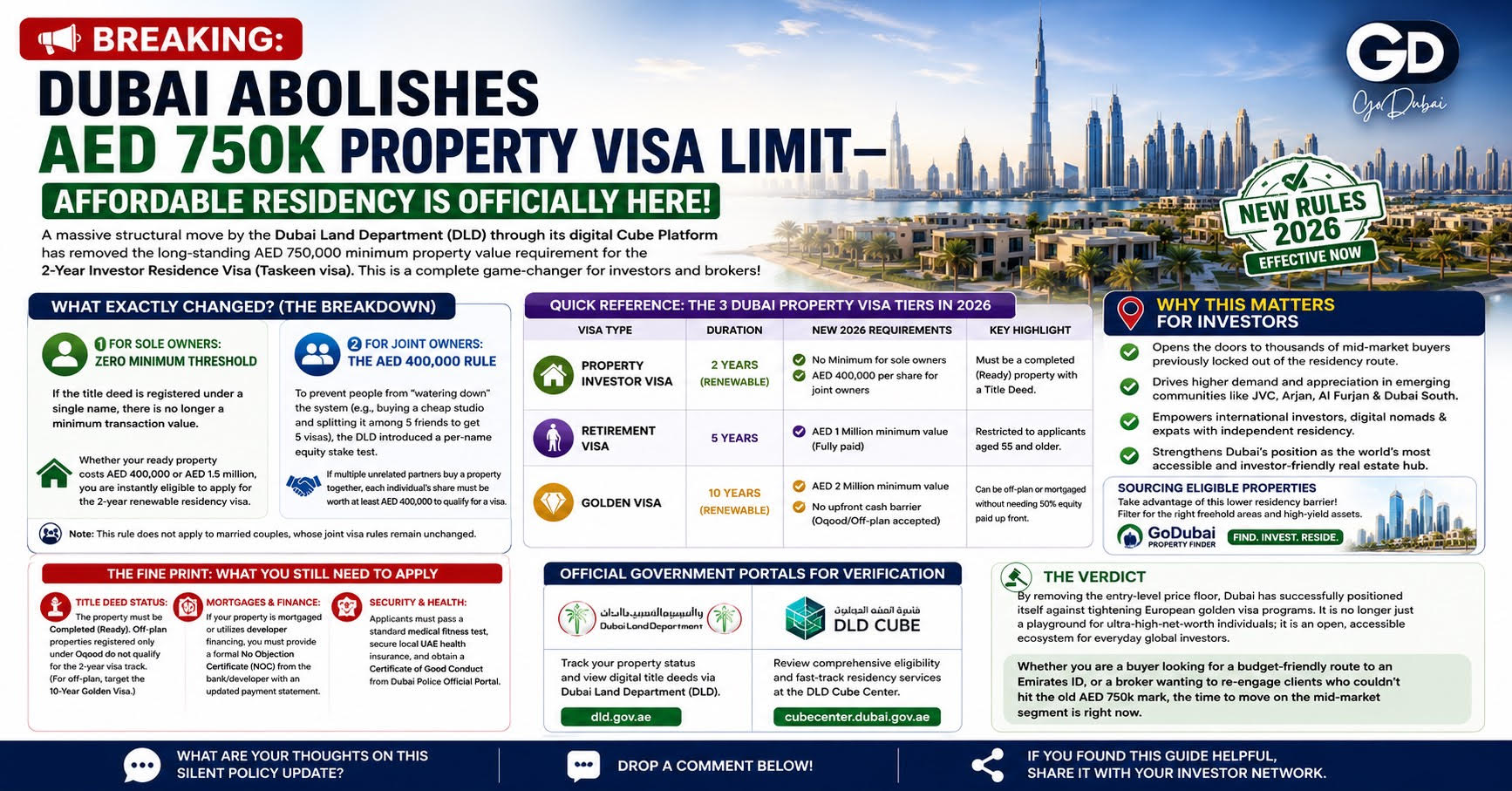
In a massive structural move implemented through its digital Cube Platform, the Dubai Land Department (DLD) quietly removed the long-standing AED 750,000 minimum property value requirement for the 2-Year Investor Residence Visa (widely known as the Taskeen visa).
This is a complete game-changer. For years, a rigid financial floor stood between mid-market property buyers and UAE residency. That floor has just been dismantled, unlocking an entirely new segment of the market. Let’s dive into exactly how the new rules work, how they impact your ROI, and what requirements you still need to fulfill.
What Exactly Changed? (The Breakdown)
The previous system was simple but highly restrictive: to get a 2-year residency visa, your property had to be worth at least AED 750,000. If you bought a great high-yielding studio in JVC or Dubai South for AED 550,000, you were completely locked out of the independent residency pathway.
The updated framework separates individual owners from joint owners for the very first time:
Find Properties Eligible Under the New Visa Rules
With the AED 750K floor removed, the mid-market is wide open. Filter and discover high-yield, ready-to-move studios and apartments that instantly qualify you for independent UAE residency.
Open GoDubai Property Finder👤 1. For Sole Owners: Zero Minimum Threshold
If the title deed is registered under a single name, there is no longer a minimum transaction value. Whether your ready property costs AED 400,000 or AED 1.5 million, you are instantly eligible to apply for the 2-year renewable residency visa.
👥 2. For Joint Owners: The AED 400,000 Rule
To prevent people from “watering down” the system (e.g., buying a cheap studio and splitting it among 5 friends to get 5 visas), the DLD introduced a per-name equity stake test. If multiple unrelated partners buy a property together, each individual’s share must be worth at least AED 400,000 to qualify for a visa. (Note: This rule does not apply to married couples, whose joint visa rules remain unchanged).
Quick Reference: The 3 Dubai Property Visa Tiers in 2026
The 2-year investor visa change is part of a broader administrative overhaul. Here is how the three main property-linked residency tracks stack up right now:
| Visa Type | Duration | New 2026 Requirements | Key Highlight |
|---|---|---|---|
| Property Investor Visa | 2 Years (Renewable) | No Minimum for sole owners / AED 400,000 per share for joint owners. | Must be a completed (Ready) property with a Title Deed. |
| Retirement Visa | 5 Years | AED 1 Million minimum value (Fully paid). | Restricted to applicants aged 55 and older. |
| Golden Visa | 10 Years (Renewable) | AED 2 Million minimum value. No upfront cash barrier (Oqood/Off-plan accepted). | Can be off-plan or mortgaged without needing 50% equity paid up front. |
Why This Matters for Off-Plan & Ready-Market Investors
This policy shift creates a massive incentive to look at mid-market properties. Previously, the AED 400k to AED 750k segment accounted for a significant chunk of transactional activity in Dubai, but those buyers were completely dependent on corporate employment visas.
Now, international buyers, digital nomads, and regional expats can purchase highly lucrative, high-yield compact units (studios and 1-beds) in emerging master communities and secure independent residency. This accessibility will inevitably drive up demand—and asset appreciation—in affordable investment corridors like Jumeirah Village Circle (JVC), Arjan, Al Furjan, and Dubai South.
📍 Sourcing Eligible Properties
If you are looking to take advantage of this lower residency barrier, you need to filter for the right freehold areas. You can use the GoDubai Property Finder to search through pre-vetted, high-yield ready and off-plan assets that align perfectly with the updated DLD parameters.
Stop Chasing Dead Numbers. Start Closing Deals.
Capitalize on Dubai’s massive real estate updates. Get direct access to high-intent, pre-qualified international buyers looking for ready and off-plan investments right now.
Get Guaranteed Verified LeadsThe Fine Print: What You Still Need to Apply
While the financial barrier is gone for sole owners, the DLD’s strict administrative safeguards remain firmly in place. To successfully convert your property into a residency visa, you must fulfill the following:
- Title Deed Status: The property must be Completed (Ready). Off-plan properties registered only under interim contracts (Oqood) do not qualify for the 2-year visa track—they must be handed over with a formal Title Deed. (If you want to use an off-plan property for residency, you must target the 10-Year Golden Visa tier).
- Mortgages & Finance: If your property is mortgaged or utilizes developer financing, you must provide a formal No Objection Certificate (NOC) from the bank/developer alongside an updated payment statement.
- Security & Health: Applicants must pass a standard medical fitness test, secure local UAE health insurance, and obtain a Certificate of Good Conduct directly from the Dubai Police Official Portal.
Official Government Portals for Verification
To keep track of processing timelines, application queues, or fee structures, always cross-reference data directly through the official state platforms:
- Track your property status and view digital title deeds via the Dubai Land Department (DLD).
- Review comprehensive eligibility and fast-track residency services directly at the DLD Cube Center.
The Verdict
By removing the entry-level price floor, Dubai has successfully positioned itself against tightening European golden visa programs. It is no longer just a playground for ultra-high-net-worth individuals; it is an open, accessible ecosystem for everyday global investors.
Whether you are a buyer looking for a budget-friendly route to an Emirates ID, or a broker wanting to re-engage clients who couldn’t hit the old AED 750k mark, the time to move on the mid-market segment is right now.
What are your thoughts on this silent policy update? Drop a comment below! If you found this guide helpful, don’t forget to share it with your investor network.